
“Don’t ask yourself what the world needs. Ask yourself what makes you come alive, and go do that, because what the world needs is people who have come alive.” -Howard Thurman
(Continued from last post)
The Rif Mountains were quite a change of scenery from Rabat and Tangier. As we left the city we drove past a large shanty town, which was intense to experience. The government of Morocco tries to pretend that they don’t exist, because the King sees them as burdens, so they build walls around them to keep them “contained” instead of trying to actually combat the problem and improve their living situations. The wall had almost completely deteriorated, so as we drove past we were able to see the grim conditions that these people live in. It is a very humbling experience to come in as an outsider and witness this extreme poverty, and then immediately return to the comfort of our everyday lives that we take for granted.
We stopped in a café for some Moroccan tea after a few hours of driving, which was somewhat uncomfortable because the cafés in Morocco are (unofficially) male exclusive. We recieved lots of puzzled, scrutinizing looks from the men. As we were leaving we stopped at a market to pick up some snacks, and were unfortunate enough to witness a chicken get slaughtered. They are very humane about the way they kill their animals, but it was still enough to make me want to go vegetarian. After the market we continued driving for a little bit, but we had to stop because our van had a tire problem. We arrived in a tiny, 300-person village nestled in the mountains a few hours later.


Our program director, Sarah, knew a family from this village from her time in the Peace Corps. It was a couple named Hamid and Farida, and their three kids. They invited us into their home, which consisted of two small rooms. We finished preparing the food and spent some time playing with their children, who were adorable. They were fascinated with our sunglasses, and Connor actually ended up giving one of the boys his sunglasses as a gift when we left.


We sat down for lunch, which was INCREDIBLE. We had traditional Moroccan couscous that was filled with yummy vegetables and potatoes, and pita bread with tomatoes, onion, cheese, and avocado. It was the most delicious food. In Morocco it is customary to have one big dish in the middle of the table that everyone eats from, and instead of using silver wear, you use your right hand (unless it’s something like soup or couscous, in which case you use a big spoon).


After the meal, we sat down with the family and had the opportunity to ask each other questions, thanks to our amazing translator Nada. We asked them about their arranged marriage, what they do in case of a medical emergency (since the village is so rural), their hopes for their children, how they view Americans, and if they ever want to move somewhere outside of their village. They asked us about American wedding traditions, our hopes for the future, and our impressions and preconceptions of Morocco. It was an amazing discussion, and they were the kindest people. They told us that if we ever want to come back to Morocco, their home is open to us. I’m not going to get into the specifics of the conversation, because that is an entirely different post, but it was extremely eye opening.


It was sad leaving the village and saying goodbye to the kids, who were so adorable. After we left, we drove another hour or so until we finally arrived in Chefchaouen, otherwise known as the Blue Pearl of Morocco. This is a place that has been on my travel Pinterest boards since I can remember, so to say that I was excited is a massive understatement. I never imagined I would ever actually get to go to Chefchaouen, and it was all so surreal. We drove around a bend in the mountain, and all of a sudden we had the most spectacular view of the entire city, just resting on the side of the mountain.
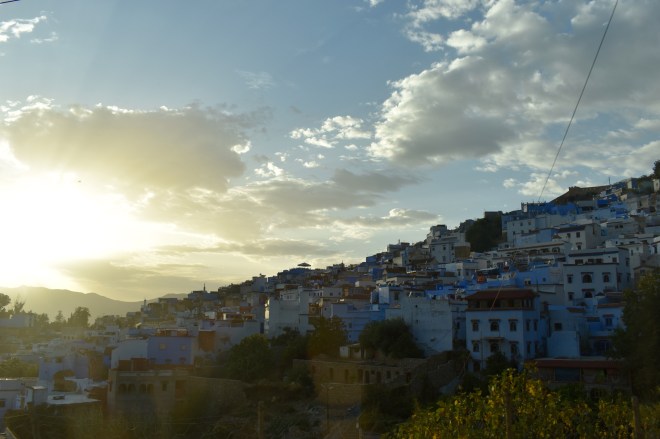
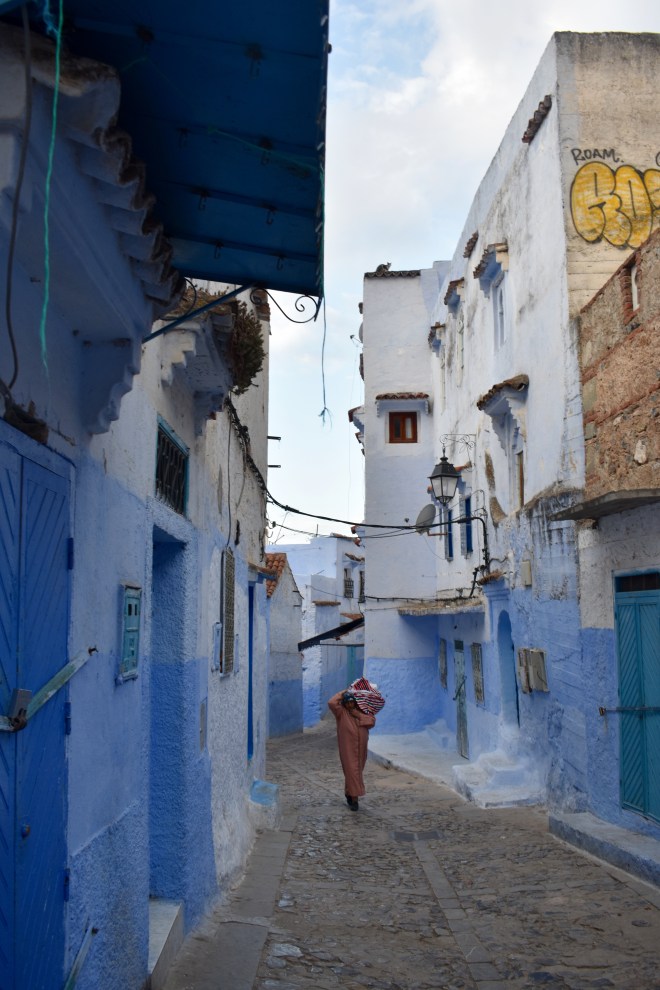
We had to walk our luggage through the narrow streets of the historic Medina to get to our hotel, and it was a total sensory overload. I felt like I was in a dream, because I couldn’t believe that I was really in this place that I’ve imagined for so long. All the buildings are painted a vivid blue, because of its Jewish history. The streets were bursting with shops displaying handmade tapestries and rugs, jewelry, vivid paintings, lanterns; literally everything you can imagine. It was also refreshing because we were now in a part of Morocco that Spain had occupied way back in the day, so most people spoke Spanish (Rabat and Tangier were more French speaking, along with Arabic, so we were pretty helpless in terms of communicating). It was a relief to be able to communicate with people without the help of a translator.


Our hostel (really more like a hotel) was beautiful, and extremely comfortable. The shower was a great improvement over our previous situation. We quickly dropped off our bags and went out to explore, because we only had two hours of free time before dinner. It was already dark out and many of the shops were closed, and we were afraid of getting lost since all the roads are so small and windy, so we didn’t get much shopping done. We did, however, get our hennas on our hands! I bought a couple small souvenirs as well, so it was successful. Our group dinner was at a gorgeous restaurant near the center of the Medina. I ordered Moroccan Salad, which is tomato, cucumber and onion with lemon, and a beef and apricot Tagine. The food in Morocco is honestly to die for. I could go on forever about the how amazing the food is, but I’ll spare you.


We got back to our hostel and had a candlelit group meeting on the rooftop deck, reflecting on our time in Morocco. As brief as it was, we all agreed that we had grown so much as people and learned more about ourselves than we ever had before. Sitting on the roof, overlooking the lights of the city and being surrounded by the mountains, was probably one of the happiest moments of my life. I have never felt as incredibly fulfilled and truly content as I did in that moment. We ended the night with a guitar jam session/sing along, and then headed off to bed.
The next morning, we woke up bright and early for a hike to a spot with a gorgeous overlook of the city. The hike was only about 20 minutes, but the high altitude made it pretty grueling. The views at the top made it more than worth it though. Looking out over the city was one of those holy shit I’m actually in Africa having one of the biggest adventures of my life, this is so surreal moments (which this trip was full of, honestly). There really aren’t words to describe it properly, so instead I’ll just put pictures.


We went back down and had breakfast, and our last Moroccan tea, and then had about an hour to do some last minute shopping. I bought a tapestry and some other souvenirs to give to people back home. When it was time to leave Chefchaouen I was really emotional, because I wanted to spend so much more time exploring. It was, hands down, the best experience of my life.
The last little adventure we had was going to Ceuta. Ceuta is on mainland Morocco, but it is a Spanish territory. This means that Moroccan citizens are not permitted here. There are Spanish and European Union flags, they use the Euro, and they are on European time (there is a one hour time difference). The border into Ceuta is one of the largest trafficking borders for humans and drugs in the world, making it pretty dangerous. Since we have the privilege of having a United States passport, we were allowed to cross through relatively easily. It was really intense. We had to walk quickly through the border, past lines and lines of cars and people waiting, through three chaotic checkpoints, and we got our passports stamped three separate times. Once we entered Ceuta, we found cabs that took us to the ship, where we crossed the Straight of Gibraltar. It was a pretty thrilling experience. Unfortunately, weren’t allowed to take any pictures of the border. Although it was a hectic ending to the trip, it couldn’t have been more perfect.
Morocco is truly a unique place; I have never been so awestruck by a country in my entire life. The people, food, architecture, clothes, religion, customs, culture, everything about it. It is a gem of a country. We felt so welcomed and accepted by the people, who were some of the most intelligent, hard-working, beautiful people I have ever had the privilege to meet. This experience changed so much for me, and I am beyond grateful for every second of it.
Shukraan for everything, Morocco.
 Idly Wild